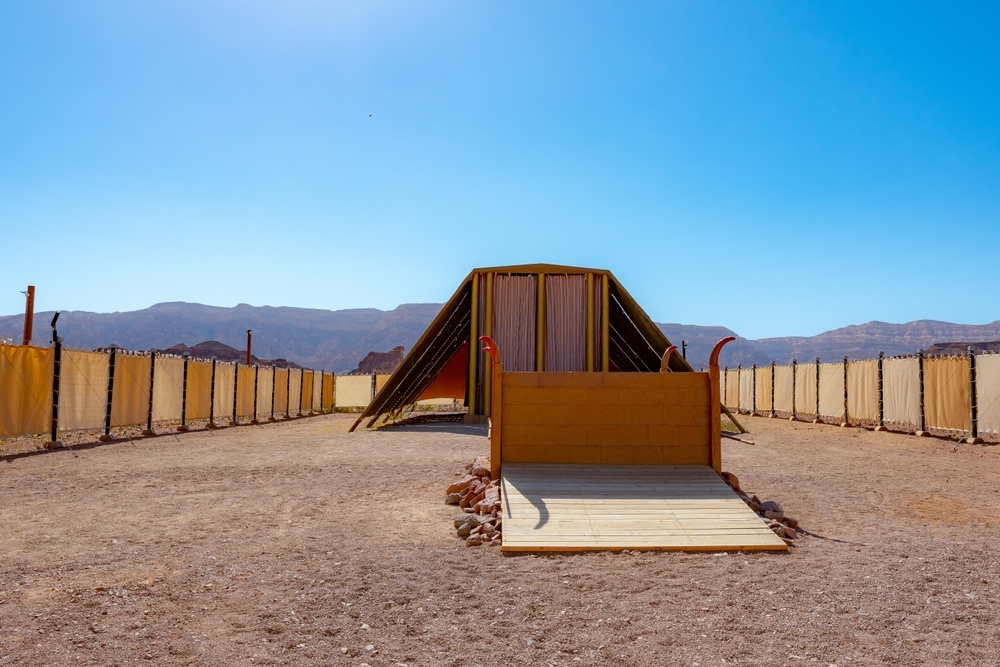
For the next five parshiot the Torah will focus on the construction of the Mishkan, delineating in great detail how it was to be built, and then with much repetition delineating in great detail the actual implementation of those instructions.
The only break from these rather tedious details is the sin of the golden calf. However, it would be rather simplistic – and incorrect – to see this tragic story as disconnected from the construction of the Mishkan. It too is part of the story of the Mishkan. How ironic that the same people who so eagerly contributed to the construction of a house for G-d – so much so that Moshe had to tell the people their donations were no longer needed – that these same people could build a golden calf.
While to our modern sensibilities this seems like a blatant contradiction, an oxymoron, to the Jewish people steeped in Egyptian polytheism, these were just two different ways to worship G-d or perhaps gods. G-d had made Himself known to Pharaoh, the Egyptians and the Jewish people and they likely realized that this G-d is the most powerful of gods, but to expect the people to give up belief in other gods would not be realistic. Weaning the Jewish people from idolatry would take many hundreds of years. It would not be until the Second Temple period that idolatry would cease to be a major issue.
The prohibition of idolatry is arguably the dominant theme of the Torah, especially in sefer Devarim. Over and over and over again Moshe warns the people not to follow the idolatrous practices of the nations dwelling in the land of Canaan. By placing the story of the golden calf within the narrative of the Mishkan the Torah is indicating that the Mishkan is the corrective to the sin of the golden calf.
This is the view of Rashi and many others who argue that the command to build a Mishkan was given only as a result of the golden calf. Had the Jewish people not sinned there would have been no need for the Mishkan. Thus, Rashi notes, that the command to build the Mishkan was given on the day after Yom Kippur (Shemot 35:1), the day G-d forgave the people for the sin of the golden calf. The best way to ensure they would not repeat this mistake was to give them an alternate, physical way to worship G-d.
It is for good reason that on top of the aron, the ark containing the Ten Commandments with its prohibition of making any physical images of G-d, there were the keruvim, two childlike figures, male and female, made of solid gold. It is in front of this aron that the High priest would enter on Yom Kippur to beseech G-d to forgive the sins of the Jewish people. The Jewish people could not relate to an abstract G-d, so G-d has to allow for some form of images, despite what was said in the Ten Commandments.
Yet if Rashi is correct it is difficult to understand why the command to build the Mishkan is written in the Torah before the sin of the golden calf. It is true that at times (at least according to Rashi) the Torah is written out of chronological order but that is only if there is some reason to do so. Here this seems to makes little sense.
Recording the Mishkan first is understandable if one accepts the view of the Ramban (who, unless explicitly mentioned in the Torah, rejects the notion that the Torah is not in chronological order) that the Mishkan is unrelated to the sin of the golden calf. The Mishkan is an ideal, not some concession to human need to physically represent G-d. It is no less than a continuation of Har Sinai, one that would accompany the Jewish people throughout time.
As the Ramban notes, sefer Shemot is also known as sefer hageulah, the book of redemption. The Mishkan was the third and culminating step in the redemption of the Jewish people that began with the physical redemption of the Jewish people from Egypt, continued with divine revelation at Sinai and is manifest with the construction of the Mishkan. It is for this reason that sefer Shemot concludes with the dedication of the Mishkan. Yet according to this view it is difficult to understand why the Torah felt it necessary to detail the actual building of the Mishkan after the golden calf. Why the seemingly needless repetition?
I would like to suggest an approach based on a halacha relating to the construction of the Mishkan[1], namely the prohibition to build the Mishkan on Shabbat. While once constructed the Mishkan operated on Shabbat it was not allowed to be built on Shabbat. This law is derived not in parshiot Terumah and Tezazveh which precede the golden calf incident but from parshat Vayakhel which follows it. By juxtaposing shabbat and the command build the Mishkan the rabbis derive that shabbat must be observed even at the cost of delaying the construction of the Mishkan. Why does the Torah wait to teach this law?
Apparently, the nature and function of the Mishkan changed after the sin of golden calf. The “original” Mishkan was to be a place where G-d’s presence permeated not just its physical structure but within each of us. “And make for me a Tabernacle and I will dwell amongst them” (Shemot 25:8) i.e. amongst the people. The first reason we keep Shabbat – the one given in the Ten commandments as recorded in parshat Yitro – is to testify that G-d is the Creator of the world.
Before the sin of the golden calf the Mishkan was so powerful and the presence of G-d was so manifest that Shabbat was not needed. G-d’s presence was felt everywhere and at all times. Even on a Tuesday the divine presence of Shabbat could be felt. However, after the sin of the golden calf we lost some of the divine presence. The presence of G-d could no longer be felt in the same way – the permanent Sinai was diminished. The Mishkan was now the way in which we humans could relate to G-d. G-d was more distant and the spirit of shabbat could not be realized during the week.
Tellingly, Jewish law stated that once the Mishkan was constructed communal sacrifices, the korban tamid and a special korban mussaf were to be brought on Shabbat. The divine presence allowed for the “violation” of shabbat. But personal sacrifices were not allowed on the Shabbat. While it is difficult for individuals to feel the all-encompassing presence of G-d, the Jewish people as a whole can, do and must.
[1] While admittedly this may not be true historically I believe the message is still relevant.