
For those looking to escape the cold weather of the Northeast, there are few better places to go than Panama. As someone who vacations in Panama in the winter told me, Panama has four seasons, summer, summer, summer and summer[1]. And this person lives in Florida. Add its relatively inexpensive cost – hotels prices are often less than half of those in many other vacation destinations – along with its “new and exciting” feel, abundant natural beauty, and unique position on both the Atlantic and Pacific coasts, and it's easy to see why Panama is a most attractive vacation destination.
Yet for an observant Jew what is truly special about Panama is its amazing Jewish community and its fabulous infrastructure. Add to that the fact that, as we were told by many, there is no anti-Semitism, no wonder there are Jewish tourists galore.
A community that numbered some 2,000 people in the early 1950’s today is home to some 17,000 members[2]. Much of the credit for the spiritual – and hence physical – growth of community must be given to Rabbi Zion Levi. A chavruta, study partner, of Rav Ovadiah Yosef, he arrived in Panama to a very different community in 1951. At the welcome dinner for the new young rabbi, the community served both meat and milk. The rabbi decided then and there he was going back to Israel on the next plane. His wife prevailed upon him to stay for at least six months and see if they could have a positive influence. Fifty-seven years of dedicated service later Panama had become one of the most – perhaps the most – observant Jewish community in the world[3],[4].
Today, some 70% of the community is shomer shabbat (at least publicly) over 80% keep kosher and over 95% of the children attend one of the four Jewish day schools. And even if the levels of kashrut and shabbat observance are inflated 100% (and they are not) the numbers are still phenomenal.
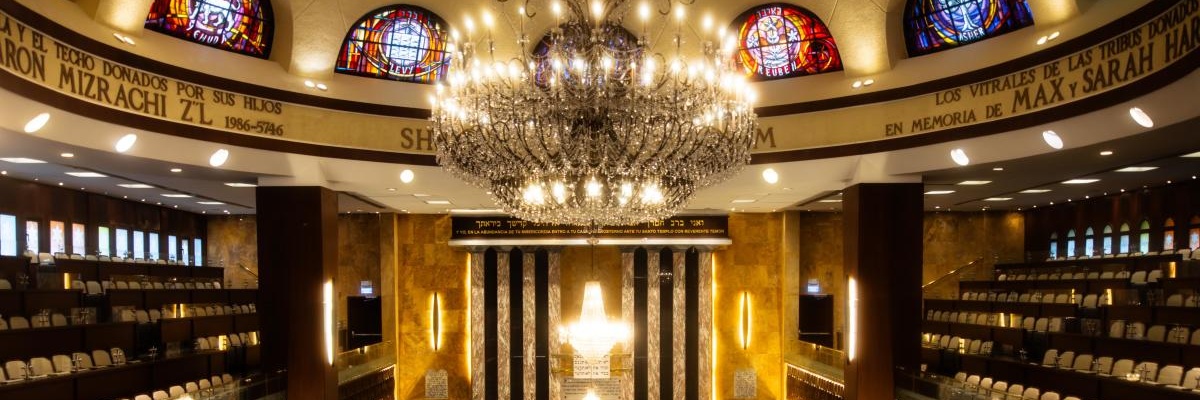
One does not join a shul in Panama. Rather one joins the kehilah, community, under whose auspices all the shuls operate. The original shul, Shevet Achim, was built in the 1930’s and is the only one of the shuls which one can tell is shul from the outside. All others are non-descript on the outside but beautiful, even awe inspiring, on the inside. One of the many indications of the care and planning that went into building the shuls are the amazing acoustics all the shuls have.
Most of the community no longer lives in the immediate area of Shevet Achim, though the other shuls – branches of Shevet Achim - are all within a thirty-minute walk.
Fascinatingly, as new shuls were built the community adopted a policy that all bar-mitzvot must take place in Shevet Achim. This is not too difficult to implement when combined with another “takkana”, communal ordinance, namely that all bar-mitzvot be celebrated on a Monday or Thursday. This was instituted by Rabbi Levi so that people would not drive on Shabbat. It is hard – actually impossible is a better description – to imagine such rules being adopted in your typical North American community.
In a similar vein, all weddings take place in the community centre and not in shul. As was explained to us this was done for tzniut, modesty, reasons as the combination of (what once was) a non-observant community and a hot climate led many to dress in a manner that the rabbi felt was not appropriate for a shul.
Rabbi Levi did not sit up front along the bimah, as is typical in most shuls, but amongst the people, a practice that is followed in all Panamanian shuls. Rather, up front is reserved for families celebrating smachot during the upcoming week.
One does not necessarily think of Panama – at least I did not until I visited – as a centre of Torah learning. But a walk into one of the kollelim, study halls, will quickly demonstrate that high level learning – both quantitively and qualitatively – is a part and parcel of the community. The community has even begun producing its own rabbis with over 20 local Panamanians having received semicha, ordination, in Panama in recent years. No longer is there a need to import rabbis.
Following the teaching of our Sages “all according to the custom of the place” loosely translated as when in Rome do as the Romans do, I davened with both the Sephardic and Ashkenazic kehilot. Davening Shacharit at a Sephardic shul is a real blessing, literally, as birchat kohanim, the priestly blessing, is done every day and not just on Yom Tov as is the custom in Ashkenazic shuls. Looking at the “bulletin board” on a Monday morning at the Ahavat Sion shul, one notices that there are 14 – yes 14! – minyanim for shacharit. Shevet Achim has “only” three minyanim on a weekday morning.
Following the Halabi custom, that is customs of the Jews from Aleppo, where most of the community originated, Kabbalat Shabbat is not said on Friday night. They do recite the first three, the fifth and the last stanza of lecha dodi, a custom for which I was unable to discover the reason. I also could not follow the derasha of the rabbi – given after the recital of Shir Hashirim – as it was in Spanish.
Those who frequent Sephardic shuls are familiar with the fact that they say each word aloud as they daven. While it slows down the davening it allows for much greater kavanah, focus. One does not expect such at an Ashkenazic shul and Beth El the (only) Ashkenazic shul in Panama city is no exception. What is exceptional is how much singing they do – even on a weekday shacharit. Ashrei, (the last of the) Halleluyahs, v’haher eineinu, emet veyatzif, tzur yisrael are all sung together. And Shabbat morning featured the traditional tunes many of us grew up with i.e. Ein Keloheinu, Aleinu etc. Catering to the many tourists, the rabbi gave a bilingual sermon seamlessly weaving between English and Spanish.
As noted above, the shuls are non-descript – on the outside. The only possible way a passerby might know it’s a shul is the presence of security guards outside the shul. One cannot get into a shul unless one pre-registers with the community, and gets a QR code which must be shown if one hopes to enter a Jewish institution. Stringent security measures were implemented years ago and are not in response to any security breaches. There have been no anti-Israel rallies in Panama. I think it behooves Jewish communities in North America (many European cities do have strong security measures) to consult with and then adopt many of these security practices.
A small indication of how well integrated the Jewish community of Panama is with the larger society is the fact that the current mayor is Jewish, and Panama is the only country in the world (outside of Israel) to have had two Jewish Presidents. Walking on the street on Shabbat one who fulfils the rabbinic dictum to ‘greet all whom we meet’ will have many opportunities to do so.
Panama excels not only in ruchniut, spiritual matters, but in gashmiot, material matters. And that too was part of the vision of Rabbi Levi. He wanted Judaism to be easily observed, joyful and that no child should feel a need to eat at McDonald’s. Hence there are kosher restaurants galore – we were handed a list with 38 kosher establishments to choose from. Great food, thoughtfully designed décor, at very affordable prices[5] – at least compared to the East coast.
There are two huge supermarkets where 100% of the products are kosher. The larger one, Super Kosher is a whopping 80,000 square feet[6] and contains a meat and dairy kosher restaurant. If it’s kosher they sell it. There are all kinds of Jewish sports leagues – started both for their inherent value and to help ensure that Jewish children would play with other Jewish children.
In many ways – and we heard this from a number of people – Panama is a Jewish paradise. And it is a community worth studying to see what we might like to emulate. At the same time it was nice to hear from our tour guide that two of her three children have made aliyah, one living in Bnai Brak and one in Tel Aviv.
[1] With Panama being situated a mere 9 degrees north of the Equator the weather forecast is pretty much guaranteed to be hot and humid. Another by-product of its proximity to the Equator is the fact that Shabbat never varies by more than 35 minutes. Sunset on December 21st is 6:04pm and on June 21st is at 6:39pm. Due to its unique shape, Panama is the only place in the world where one can see the sun rise over the Pacific Ocean and set over the Atlantic Ocean on the same day.
[2] 15,000 belong to the Sephardic community and 2,000 to the Ashkenazic community. There is a separate Reform community numbering 1,000 and Chabad which operates outside of the kehillah structure.
[3] I do not know if this story is true, but it need not literally be true to reflect the truth. Another story our guide told us is that seeing his impact, Rabbi Levi was offered the position of Sephardic chief rabbi of Israel. He said he could not leave his community and suggested they approach Rav Ovadiah Yosef instead. While I strongly suspect this story may not be “true” it shows the esteem to which their rabbi is held. There is much one can learn from stories – especially if one realizes they are stories.
[4] To the best of my knowledge the only two places with a higher percentage of Shomrei Shabbat are Gibraltar and Djerba, Tunisia in both of which there is no public desecration of Shabbat (and both of which Torah in Motion has visited). However, both communities number approximately 1,000 Jews. Not only is Panama much larger but unlike Gibraltar and Djerba the community was not always a primarily observant one.
[5] At perhaps the fanciest restaurant in Panama city we had an appetizer, soup, main course and dessert for under $60. Let’s just say it would cost more in New York.
[6] To put this in perspective the average size supermarket in the United States is 42,000 square feet, and the average Costco store is some 147,000 square feet. That a kosher supermarket in Panama be more than half the size of a Costco is really quite remarkable. To add a Toronto comparison – the Sobeys on Clark is a mere 44,451 square feet.