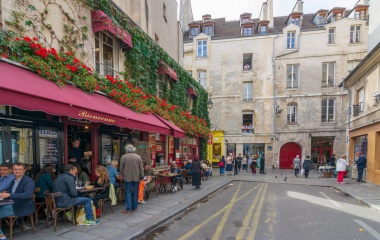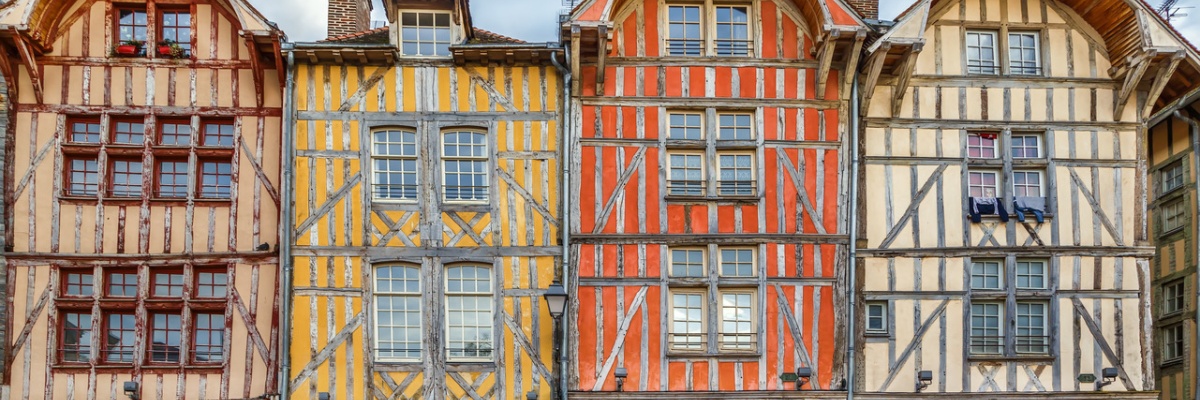
Few people who visit France visit Troyes, a city of fewer than 100,000 people, located some 90 miles southeast of Paris. In medieval times the city of Troyes was an important centre of commerce hosting many fairs, and from the 18th through the mid 20th century was the centre of the French textile industry – it was here in 1933 that Rene Lacoste and André Gillier founded the Lacoste clothing company.
It is the city of Troyes that produced the greatest of Biblical and Talmudic commentators, arguably the most influential Jew since Talmudic times and perhaps even including Talmudic times. Rav Shlomo Yitzchaki, more commonly known as Rashi (1040-1105), was born and died in Troyes and save for a few (important) years studying in the Yeshivot of Worms and Mainz, spent his entire life there.
It is Rashi who opened up the study of Talmud. If not for his commentary on the Babylonian Talmud it would remain today a closed book for all but a very, very few scholars of the absolute first rank. The fact that he did not write a commentary on the Jerusalem Talmud helped ensure it would, and has remained, a closed book even for the vast majority of those who study Talmud[1]. This, despite it being much less discursive, more concise and much shorter than the Babylonian Talmud. Without Rashi Talmud borders between difficult and impossible to understand.
Whether one studies Talmud or not – and until post World War ll the vast majority, some 95% of the Jewish people did not – all who have even a cursory knowledge of chumash are aware that Rashi is its commentator par excellence[2]. So important and influential is his commentary that the Talmudic law that one is to review the weekly Torah reading twice in the original Hebrew and once in the Aramaic translation of Onkelos, was “amended” such that one can fulfil one’s obligation of reading in translation by reading Rashi. This despite the fact that Rashi does not comment on every verse.
So fundamental is Rashi’s commentary that it was the impetus for a third Hebrew font. As may not be widely known, the original Torah script was, according to many, written in ketav ivri, a Paleo-Hebrew script that few if any reading this, myself included, would be able to read. During the time of Ezra, the script was changed to what is known as ketav ashurit, Assyrian script[3]. Rashi script was not, contrary to popular belief, the way Rashi wrote Hebrew, but was rather invented by the printers. In the early days of the printing press it was hard to clearly distinguish the text from its commentaries. In order to make the distinction clearer, a new font was developed. Since it was Rashi that was the most important commentary and pretty much part and parcel of every chumash, this new style of lettering is what we might call today “rashi font”.
Part of the greatness of Rashi is that his commentary was written both for the layman and great rabbinic scholar alike. Anyone with a rudimentary knowledge of Hebrew can read Rashi in the original and gain many wonderful insights into the Torah. Today one does not even have to know Hebrew as Rashi has been translated into many languages. At the same time Rashi’s commentary can only be fully understood if studied in great depth. It is a commentary fully appreciated only by Talmidei and Talmidot Chachamim[4] (Torah scholars).
Rashi’s use of midrashim has spawned much scholarly debate, raising such questions as his use of part, but not all, of a midrash, placing a midrashic comment to a different verse than the midrash does, why at times Rashi refers to a midrash without actually quoting its content, why sometimes the midrashic comment comes first and sometimes only after an alternate explanation has been quoted. And the key question is why does he quote midrashim at all? After all, Rashi himself tells us (Breisheet 3:8) that while there are many beautiful midrashim he has come to explain only the pshat. It is not easy to translate pshat and we will suffice by saying it refers to the “plain” and/or the contextual meaning of the verse.
It is commonly assumed that Rashi was a vintner. As Dr. Haym Soloveitchik notes, there is no evidence of such and while it may be true, by the same token he may have been an egg salesman. If he was a vintner it was not in Troyes as the land around Troyes, unlike much of France, is not suitable for wine growing.
In a similar vein there is no evidence that Rashi’s daughters wore tefillin. If I were to speculate, I would suggest this “legend”, which may be true, arose because Rashi had no sons (as far as we know)[5].
Troyes today has a Jewish community of some 100 families. They have a beautiful shul – and no fewer than nine sifrei Torah. Most importantly the community has a rabbi who comes to Troyes every shabbat and special occasions to lead the minyan. The community is actually in the process of hiring a new rabbi as the previous rabbi left a few weeks ago for a position in Paris[6]. We had a delightful lunch at the community centre – known as The Rashi House – and met with the woman president of the community. In 1989 the city opened the Institut Universitaire Européen Rachi (Rashi European University Institute), a research centre dedicated to “themes linked to Judaism and, more generally, to dialogue between cultures and religions”.
The students and descendants of Rashi – many one and the same – are known as the Tosafists, literally the additions. As great and important as they are their commentaries are viewed as add ons to Rashi[7]. In other words, without Rashi there would be no Tosafists. And much of the commentary of the Tosafists begin by quoting Rashi, more often than not, explaining why they disagree with him.
One of Rashi’s most illustrious descendants is his grandson, Rav Shmuel ben Meir, knows as the Rashbam. We travelled to Rouen about 85 miles northwest of Paris and as the crow flies 155 miles from Troyes. It was here in 1976 during excavations conducted by the city that the yeshiva in which the Rashbam taught was discovered. Its antiquity can be seen by the writings still etched into the walls.
Unlike his younger brother Rabbeinu Tam, the Rashbam studied with his grandfather in Troyes. In what is likely his most famous piece (Breisheet 37:2) he notes how he debated much with his grandfather who confessed that if he would have had more time he would have re-written his commentary of the chumash “according to the pshat that renews itsself each day”.
The Rashbam was the pashtan par excellence eschewing all midrash in his commentary. And by that I refer to midrash halacha, legal midrashim. He argued that many midrashim were not in keeping with the pshat of the verse and in his biblical commentary would explain the verse in accordance with the pshat even if it contradicted Jewish law. The most fascinating example is his assertion that according to the pshat of the Torah a day starts in the morning. He understands the verse vayehi erev vayehi boker, to mean it was night and morning, and it was in the morning that the new day begins. The Rashbam of course fully observed halacha and began shabbat on Friday night. Pshat and Midrash need not agree with each other, each serving its own important function[8].
Rashbam was also a great Talmudic commentator and it his commentary, not Rashi’s, that is the standard commentary to the tenth chapter of Pesachim, which discusses the Pesach seder.
But as great as his commentary was, he was no Rashi[9]. On page 29a of tractate Bava Batra there appears a note in the middle of the page that says, “until here is the commentary of Rashi zt”l, from here is the commentary of Rav Shmuel the son of Rav Meir ”. If one continues to learn Bava Batra one begins to appreciate how Rashi was a man of few words. What Rashi could say in three words would take the Rashbam three sentences. It is not by chance that Bava Batra is the longest tractate of the Talmud, ending on page176.
The notion that pshat and derash do not align was in direct opposition to one of the Rashbam’s neighbours in Rouen, the Ibn Ezra[10] who was horrified by such a concept arguing that they must align. I find this most interesting as the Ibn Ezra had some pretty radical ideas of his own, including the possibility of post Mosaic additions to the Torah.
Rouen today is a community of some 200 Jewish families. There is a Chabad centre and a non-Chabad shul led by the Chabad rabbi. Unfortunately, currently all davening is taking place in the (smaller) Chabad centre due to a grenade that was hurled into the synagogue by a terrorist in May 2024. One can still see much of the damage and at the same time see what a nice shul it was. Thankfully, no one was injured in the attack.
[1] With the return of the Jewish people to the Land of Israel, there has been renewed interest in the study of the Jerusalem Talmud. Yet ask anyone who studies it and they will bemoan the lack of Rashi.
[2] A rabbinic insult to note one’s ignorance is to say that person can’t even read Chumash and Rashi.
[3] The Talmud notes that so great was Ezra that he deserved to be the one to receive the Torah, however Moshe beat him to it. As he could not be the one to receive the Torah the font of the Torah was changed such that Ezra received what one might call a “new” Torah (Sanhedrin 21b). It was during the time of Ezra and due to his founding of the Anshei Kneseet haGedolah that the Oral Law began its great development.
[4] Talmidei and Talmidot are nouns and Chachamim the object such that the proper term for a women Torah scholar is Talmidot Chachamim and Chachamot.
[5] Some of the great women scholars throughout history are those who had no brothers and thus their fathers would invest their energies into educating their daughters.
[6] During Rashi’s lifetime there was no known Jewish community in Paris.
[7] This is comparable, lehavdil, to the comment that all of philosophy is a mere footnote to Plato.
[8] Listen to our interview with Dr. Martin Lockshin, the foremost expert on the Rashbam here.
[9] As the Chafetz Chaim rules it is not lashon hara, forbidden speech, to say that one scholar is greater than another.
[10] The Ibn Ezra spent many years travelling from place to place but spent a number of years in Rouen.