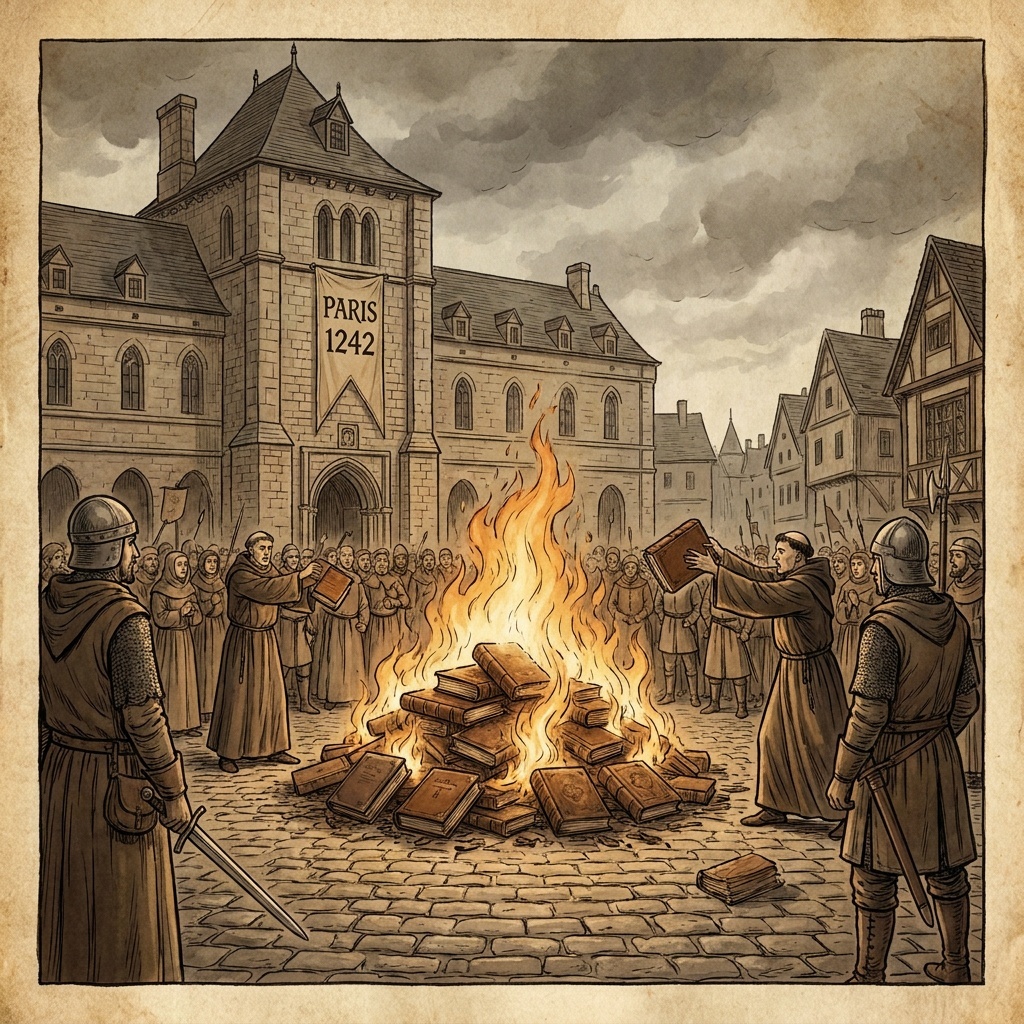
This Thursday, Tisha b’Av, as we sit on the floor lamenting the destruction of the Temples[1], we will read the kinnah, “Sha’alei Serufah baAish, Ask, O Burned One [the Torah] in the fire”. This kinnah was composed by Rav Meir of Rothenburg, considered the last of the Tosafists, after witnessing the burning of the Talmud in Paris in 1242. Twenty-four wagon loads were filled with any and every Talmudic manuscript that could be found and publicly burned. In an era before printing, where only the very rich could afford books this was a monumental tragedy. Imagine everything that was ever stored on a computer – even only your computer – being wiped away with no backup and perhaps we can begin to appreciate the monumental loss.
Not surprisingly a fast day was declared and observed for many years to commemorate this tragedy, which took place on Friday June 13, the week of parhat Chukat. Interestingly, the fast was not established on the Hebrew date of the burning itself. Instead, it was observed on the Friday of parshatChukat.
The burning of the Talmud took place after the Paris Disputation of 1240. In medieval times it was common for Christian authorities to summon leading rabbis to debate the merits of each religion – the official outcome a foregone conclusion. The Paris disputation was initiated by Nicholas Donin, a Jewish apostate to Christianity, an all too common occurrence. These apostates were especially dangerous as often they were extremely knowledgeable of Jewish learning and could pinpoint our “weak” points.
The problem of apostates goes back pretty much to the founding of Christianity and was so prevalent that as early as the second century Shmuel HaKatan[2] was tasked to compose a prayer against such apostates. And even today, three times a day we say a version of this prayer, vlemalshineem, as we recite the Shemoneh Esrei.
Nicholas Donin argued that the Talmud is full of blasphemy against Jesus and Christianity – and for obvious historical reasons there is some truth to such an argument. Over the years many of these passages were censored – some by Jews and some by Christians. Thankfully on many levels, these passages have been put back in most editions of the Talmud today.[3] One of the most amazing “recovered” censored texts is one found not in the Talmud but in the Rambam. I will let the words speak for themselves.
“Jesus of Nazareth who aspired to be the Mashiach and was executed by the Beit Din, Jewish court, was also alluded to in Daniel's prophecies…All the prophets spoke of Mashiach as the Redeemer of Israel and their Saviour who would gather their dispersed and strengthen their observance of the mitzvot. In contrast, Christianity caused the Jews to be slain by the sword, their remnants to be scattered and humbled, the Torah to be altered, and the majority of the world to err and serve a god other than the Lord”.
One can easily understand why this would be most offensive to Christians – and such a view would be well known to all, especially Jewish apostates. Yet at the same time the Rambam continues…
“Nevertheless, the intent of the Creator of the world is not within the power of man to comprehend, for His ways are not our ways, nor are His thoughts, our thoughts. Ultimately, all the deeds of Jesus of Nazareth and that Ishmaelite who arose after him are to prepare the way for Mashiach's coming and the improvement of the entire world, motivating the nations to serve G-d together” (Hilchot Melachim 11:7-8).
The Rambam goes on to explain how Christianity and Islam have through their teaching spread the idea of a messiah around the world. By discussing and arguing how the mitzvot of the Torah no longer apply, how they are the bearers of the true religion and the messiah has already come, it keeps the issue of Torah, mitzvot and the messiah on the agenda so that these concepts are not foreign. When the Mashiach does come all peoples will be receptive to his words and the truth will be revealed.
The Rambam himself notes that avodah zara began with wonderful intentions, that of serving G-d but many made the understandable mistake of assuming that serving G-d meant we should serve that which He created. The Torah considers that a most severe error but at least avodah zara contains avodah, worship of G-d, such that much that is positive can come to Jews and the world at large from avodah zara[4].
The main defender of the Talmud during the Paris disputation was Rav Yechiel of Paris, one of the greatest of the Tosafists. He put forth an original and unique argument, one dismissed by scholars and likely not even believed by Rav Yechiel himself, namely that the negative comments about Jesus are actually about an earlier person named Jesus.
Rav Yechiel’s primary argument was that destroying the Talmud was destroying the Jewish people[5]. And that argument is 100% correct. As Adin Steinsaltz noted, a Jewish community in which Talmud is not studied soon disappears. Our entire way of life is based on the Talmud. Law, philosophy, ethics, theology, legends and more. Take them away and Judaism disappears which is something the Catholic Church cannot allow. Classic Christian theology teaches that Jews are meant to be degraded and treated as second class citizens or worse. But they are not to be killed. Jews and Judaism must exist as a witness to what happens to those who reject Jesus. Rav Yechiel tried unsuccessfully to use Christian theology to prevent the burning of the Talmud[6].
In keeping with the Jewish tradition of looking inwards in response to suffering, Rabbeinu Yonah Gerondi saw the burning of the Talmud as Divine punishment[7]. In 1232 the rabbis of Northern France burned the books of the Rambam[8] considering them heretical. Rabbeinu Yonah who was initially a staunch opponent of the Rambam saw the burning of the Talmud as midah kneged midah, measure for measure, for the burning of the books of the Rambam. This traumatic event caused him to repent and to attempt to go to the Rambam’s grave in the Land of Israel to seek forgiveness[9]. There is a tradition that this was the impetus for writing his classic work, Shaarei Teshuva, the Gates of Repentance.
The long history of anti-Semitism cannot be wiped away by granting Jews equal rights, as important as that may be. While the stain of religion-based anti-Semitism has not fully abated it has been superseded by other forms – racial, nationalistic and now today anti-Zionism. The most famous case of French anti-Semitism was the canard that Alfred Dreyfus, a French army officer, was a German spy. Convicted in 1894 he was sent to Devil’s Island and exonerated only in 1906.
If one were looking for more evidence that we cannot understand the ways of G-d one need look no further than Alfred Dreyfus. It is very possible that if not for the Dreyfus affair there might not be a State of Israel. Had Theodore Herzl, a reporter for the Vienna based Neue Freie Presse, not been assigned to cover the Dreyfus trial he would not have founded the modern Zionist movement. There would have been no Zionist Congress in 1897 in Basel and Herzl could not have written in his diary “Were I to sum up the Basel Congress in a word—which I shall guard against pronouncing publicly—it would be this: At Basel I founded the Jewish State. If I said this openly today, I would be answered by universal laughter. Perhaps in five years, certainly in fifty, everyone will perceive it."
For better or for worse, it often takes anti-Semitism to bring Jews closer to their people. There truly is “nothing new under the sun”.
[1] The Talmud lists five reasons for the fast of Tisha b’Av, the most famous being the destruction of the Temples in 586 BCE and 70 CE. However, that is only the historical reason for the fasts. We are actually fasting today because of the Jewish people have not repented for their sins. As every serious thinker from the time of the prophets to today notes, the purpose of the fast is not the fasting but to lead us to repentance – to feed the hungry, clothe the naked and care for the widow and orphan. Fasting, sitting on the floor, reciting kinnot are just means to an end. It is much easier to focus on the means but much more important to focus on the ends.
[2] Rav Kook beautifully explains that the only teaching of Shmuel HaKatan recorded in the Mishna is him quoting the verse “When your enemy falls do not rejoice”. Only one who takes no joy in the downfall of an enemy can compose a prayer against that very enemy.
[3] For reasons I am not familiar with the ArtScroll Talmud has not restored the original text.
[4] The Rambam and pretty much all Jews in the medieval period considered Christianity but not Islam to be avodah zara. Today that is no longer true and most Jews have adopted the view of the Meiri (1249-1306) that religions that teach moral values cannot be considered idolatrous. It is morality that is the basis and purpose of religion. Hence as Christian attitudes toward Jews changed so did Jewish attitudes towards Christians.
[5] Just this past week Former White House Chief of Staff Rahm Emanuel told the mayor of New York that the expression “from the river to the sea” is a call for the destruction of the Jewish people. Whereas earlier generations could survive by the study of Torah today we need a State of Israel. When asked why “our generation” merited the State of Israel Rav Soloveitchik simply said “we needed it”.
[6] Ironically the nature of these debates did a 180 degree shift a mere 23 years later. Here another apostate Pablo Christiani in his debate with the Ramban in Barcelona argued that the Talmud proves that Christianity has replaced Judaism.
[7] It was because it was seen a s a Divine decree, a chok of the Torah, the fast was established to occur on the Friday of parshat Chukat, which begins “zot chukat haTorah, this is the decree of the Torah.
[8] Whether they actually burned it themselves or gave them to the Church to burn matters little.
[9] This would be in keeping with the ruling of the Rambam that if one has sinned against one who is now deceased one must bring 10 people to their grave and seek forgiveness.