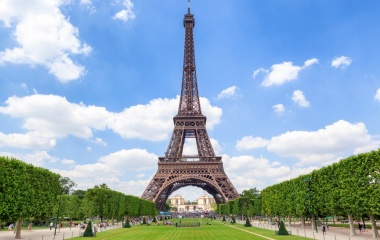
The City of Lights. Paris gets its moniker due to its being amongst the first cities to use gas street lamps and due to its being a centre of enlightenment, joining what we might call the physical and the spiritual. For a shabbat observant Jew travelling to Paris in the summer one might add an additional reason, namely that Shabbat ends after 11:00pm. There is much natural light in summer in Paris.
“Liberty, Equality, Fraternity”, the slogan of the French Revolution, was meant for all and in 1791 France became the first country to grant the Jewish people equal rights[1]. The darkness of discrimination was – at least officially – to exist no longer.
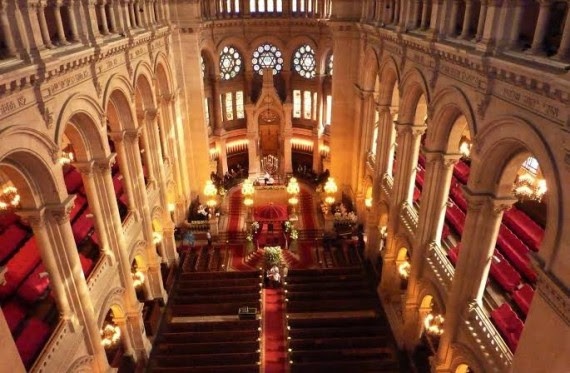
It should not come as a surprise that Napoleon lll, the first President of the French Republic and a nephew of Napoleon Bonaparte, gifted the Jewish people a large tract of land on which to build a grand synagogue. And grand it is. With much of its funding coming from its most famous members – the Rothschild family – no expense was spared and it shows. It is an awe-inspiring building as a shul should be. Completed in 1874 (construction took seven years) it is the second largest synagogue in Europe – the Dohany in Budapest being the largest – seating some 2,000 people and rises to a height of 36 metres. Like many shuls across the world it is full only on Yom Kippur.
It was in this shul that Alfred Dreyfus was married in 1890 and a few years later a Jewish journalist, by the name of Theodore Herzl, became a member of the shul. Herzl, coincidentally born literally next door to the Dohany Synagogue, was sent to Paris to cover the trial of Dreyfus.
Being technically owned by the State[2] the shul was spared during the Holocaust as French government buildings were not targeted. Sadly, on the walls outside the main sanctuary are four large plaques listing over 1,200 names of Parisian Jews who gave their lives fighting for France in World War 1.
Davening in different shuls reaffirms the beauty and diversity of our tradition[3]. The shul follows the Ashkenazic tradition of Frankfurt, but like all communities develop their own unique customs.
Jewish tradition is such that established practices become hallowed and are observed long after the original reason for them is no longer applicable. Included in this list would be the custom for Ashkenazic Jews not to eat kitniot on Pesach, reciting the haftarah every shabbat, the second day of Yom Tov in the diaspora and many more.
Moreover, at times a minhag, custom, takes on a life of its own becoming ritualized to the point that the original concept behind the custom is actually ignored. In medieval times – before one could send an email or whats app message or even call – travelling Jews would come to shul knowing their needs would be taken care of. Hence the practice developed to say kiddush in shul on Friday night as there were often visiting Jews eating there. While many shuls have abandoned this practice, Ashkenazic shuls retains this custom. Hence Friday night kiddush was made in shul after the amidah and yet a few minutes later when we, along with some 40 other people, ate shabbat dinner in the shul they once again made kiddush, turning a very practical custom of saying kiddush during the Friday night davening into a religious ritual with no practical application.
Another interesting custom was the singing of shalom aleichem before aleinu as part of the davening. Yet here too we still sang shalom aleichembefore starting the meal. Being that we are in the midst of the “three weeks” lecha dodi was sung to the tune of eli tzion, the last of the kinnot recited on Tisha b’Av [4] – a custom that many observe only on the shabbat before Tisha b’Av.
Friday night we sat with an observant couple from Trondheim Norway, some 500 kilometres north of Oslo enjoying a few days of vacation in Paris. I asked when shabbat ends in the summer and he smiled and said that’s not a simple question. As the sun never actually sets at this time of year it is not clear when Shabbat might end. He explained that when the community was established, they asked the rabbis of Budapest who suggested they begin Shabbat at 5:30pm and end it 25 hours later at 6:30pm which is exactly what they do – 52 weeks a year. They did add that generally tourists do not follow this and rather make havdallah on Sunday morning[5] (and I suppose early on Shabbat afternoon in the winter).
As was the custom in Germany and still is the practice of the Breuers community in Washington Heights, kabbalat shabbat is said responsively with the chazzan and congregation alternating verses. This was a way to distinguish the 16th century “invention” of the kabbalat shabbat service from maariv, the evening service for Shabbat.
Many congregations note this difference by having the chazzan daven kabbalat shabbat from the bimah before moving to the front of the shul to lead maariv. The Grand Synagogue makes the distinction between these two parts of the davening even sharper by having the chazzan face the congregation during kabbalat shabbat. They do the same for kriat hatorah, the public reading of the Torah. While many in America would find this strange – and associate it with non-orthodox synagogues – its logic is quite compelling. With the primary function of kriat hatorah being that of teaching Torah to the public it makes sense that one should face those whom one is teaching. This is in contradistinction to davening where we are meant to be praying to G-d and thus it would be the antithesis of prayer for the chazzanto face the congregation.
This notion that a shul is a place where we deepen and strengthen our relationship to man and G-d is symbolized by the inscriptions in the front of the shul high above the aron kodesh and at the back of the shul. In front, in the direction in which we pray, the inscription is the second verse of the shema that “we must love G-d with all our heart, our soul and might”. And when one faces the people i.e. the back one notes the inscription “to love your neighbour as yourself”– both inscribed in French.
One custom that I don’t believe I have ever seen before is the chazzansaying birchat hatorah the blessings of the Torah, said right at the beginning of shacharit out loud. After birchat hamazon, these blessings are the most important in our liturgy. Yet by every siddur placing them at the beginning of the siddur before the traditional starting point of the chazzan, many do not recognize its importance and may miss saying them. After all, if it was so important why not say it aloud[6].
I imagine what most would find especially unique is the choir. While choirs were common a couple of generations ago they are (in my mind unfortunately) much less so today. But this is not your regular choir. It is a professional choir – composed of those who sing in the Paris Opera – as becomes obvious when one hears them sing. Moreover, only one of the six men in the choir is actually Jewish, a detail that is unusual to say the least. Interestingly, the community did insist on hiring a choir director who is Jewish, bypassing a non-Jewish male director in favour of a Jewish woman.
Sunday morning, I attended a local Sephardic shul. As is common in Sephardic shuls every word of the davening is said aloud. And that includes the first three brachot of the shemoneh esrei which are said together up until kedusha. After kedusha all continue the shemoneh esreiquietly – what we call a “heiche kedusha, a half kedusha” where the rest of shemoneh esrei is not repeated. While this is relatively common in yeshivot for mincha, it is – or so I thought – unheard of for Shacharit. When I asked the rabbi he explained that this is the long standing practice of the shul. It is based on the practice of the Rambam who abolished it due to people talking instead of listening – a practice I think is most worthy of following where necessary[7].
[1] In that same year the first amendment to USA constitution was passed guaranteeing freedom of religion. However, many States had laws forbidding Jews from holding public office. It is not coincidental that France was the first European country to recognize the United States of America.
[2] In 1905 France officially became a secular state and became the owner of all religious buildings built before 1905. In order not to be illegally funding religion all religious buildings pay a symbolic rental fee to the State.
[3] Rabbi Yechiel Michel Epstein in his introduction to his code of Jewish law, The Aruch Hashuclhan, notes that one of the many miracles of Jewish history is how much unity there actually is. That Jews around the world, unable to communicate with each other, say pretty much the same words in davening, often even singing the same tunes, blow the same shofar, read the same megillah, and observe so many similar customs is remarkable. It truly is amazing to walk into a shul halfway around the world and feel right at home. As to some of the variations in practice he notes “does it really matter if one says Hodu before or after Baruch Sheamar”.
[4] In actual fact this tune was originally composed for lecha dodi of shabbat chazon (or the three weeks and later adopted for Eli Tzion.
[5] While this was a “wow” moment for me this practice is not as radical as it sounds. The question of what to do when travelling above the Arctic circle is raised in the commentary of the Tiferet Yisrael to the Mishna and he offers a number of possibilities. One is to observe shabbat based on where one came from – a suggestion that has no applicability to a permanent Jewish community, to observe it based on the nearest place where the sun sets, or to base it on the time in Jerusalem. What all these possibilities have in common is that Shabbat is observed for one day every seven days but a day is not – and cannot – be defined by the rising and the setting of the sun.
[6] It seems that the reason it is said before the official beginning of the morning prayer service is that many would come to learn before davening and hence would be required to say birchat HaTorah.
[7] There is no doubt that the prohibition of talking during davening is a greater prohibition than the fulfilment of the obligation to repeat the Shemone Esrei which was enacted so that those who could net read Hebrew would fulfil their prayer obligation by answering amen during the repetition of the amidah.