
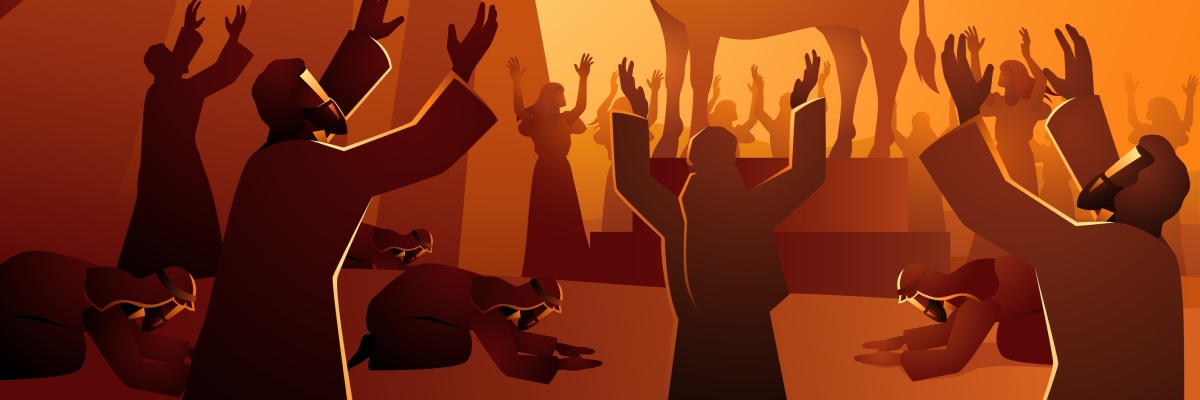
G-d was ready to destroy the Jewish people. A mere 40 days after hearing His voice these same people were dancing around a golden calf. G-d had had enough of the people and told Moshe “Go down because your people (apparently, they are no longer G-d’s special nation) who you took out of Egypt are corrupted" (Shemot 32:7).
Moshe would have none of it. As the Talmud graphically explains “Moshe grabbed the Holy One, Blessed be He, as a person who grabs his friend by his garment and said before Him: Master of the Universe, I will not leave You be until You forgive and pardon them[1]” (Brachot 32a).
Whether or not Moshe listened to G-d's command the Torah does not tell us. Rather, it details three arguments Moshe then advanced – perhaps while still holding onto G-d’s garments – as to why G-d should not be angry with the Jewish people. G-d, Moshe begins, why be angry at the people who You (not me) took out of Egypt?
Moshe does not develop this argument but perhaps the discussion went something along these lines: G-d argued that I took them out of Egypt to ‘serve me on this mountain’ and if they are going to worship idols why shouldn’t I kill them? To this Moshe may have advanced two counter-arguments. You took them out of Egypt because they are “Your eldest child” (see Shemot 4:22) and a parent never abandons a child.
Furthermore, You took them out of Egypt, Egypt the civilization steeped in idolatry with gods galore. What else did You expect the Jewish people to do? Can’t You see G-d that they want to worship a deity. True they don’t yet understand that You have no physical form but is it realistic to expect they should grasp that so soon after leaving Egypt?
Moshe then advances a second argument. What will the Egyptians say? You will look weak, maybe even foolish, as the Egyptians will say that You are too weak to take them to Canaan so You killed them in the mountain. This will be a desecration of Your name[2].
The final argument Moshe makes is You made a covenant with Abraham, Isaac and Jacob and promised that their descendants will inherit the land of Canaan. You G-d cannot destroy them.
Moshe’s arguments worked perfectly. “Vayenachem[3], And G-d was sorry regarding the punishment he Had planned for His people” (Shemot 32:14).
It is thus rather shocking to read the aftermath of G-d’s forgiveness. Moshe comes down from the mountain, sees the people dancing around the golden calf “and he became enraged” and smashed the tablets containing the 10 Commandments inscribed by G-d. Did he just not plead with G-d not to be angry and to forgive the people? Was that just for G-d but not for him? Is this not the height of hypocrisy?
Yet Moshe is just getting started. He yells at his brother, “What did this people do to you that you have brought such great sin upon them?” He then asks all who are for G-d to join him and then instructs them, “This is what the Lord G-d of Israel has said, ‘Let each man put his sword on his hip and pass through from gate to gate in the camp. Let each man kill [even] his brother, each man his friend, each man his relative” (Shemot 32:27). This is, at least textually, a blatant lie. G-d said nothing of the sort. What He said, at the urging of Moshe, is that He is sorry for even contemplating hurting the Jewish people.
What happened to Moshe on his way down the mountain?
Perhaps Moshe’s anger was directed at those who were directly involved in worshipping the calf, a very small percentage of the people. While the people as a whole could be forgiven the ringleaders could not.
While plausible I don’t think this holds up under scrutiny. G-d had told Moshe very clearly that the people were worshipping a golden calf and there was no distinction that was made – or even existed – between ringleaders and by-standers. Moshe was clearly praying on behalf of all – even, or especially, those actually worshipping the calf.
One might suggest that while up on the mountain Moshe was sincere and passionate in his defence of the Jewish people. But when he came down and saw with his own eyes what was going on he changed his view – and expressed what G-d was initially thinking.
While actually seeing what the people were doing has much more of an impact than hearing about it – even if G-d is the source of the information – such a reversal is quite extreme. And I would argue it is not to the credit of Moshe[4]. We have seen and will continue to see that Moshe had a temper and often acted impulsively. His killing of the Egyptian[5] hitting a slave led to him having to flee Egypt and his hitting the rock and/or yelling at the people cost him the chance to lead the people or even enter the Land of Israel.
Like the Jewish people Moshe too was taken out of Egypt and he too had much to learn. The Moshe we meet at the burning bush is a very different Moshe we see on his return to Egypt. And that Moshe continues to grow as he takes the people to Sinai. Yet his unparalleled greatness meant that it was hard for him to accept the murmurings and sinning of the people. And in this task, a most difficult one it needs be noted, he never fully succeeded.
I would like to suggest that G-d never intended to destroy the people. Rather, His goal was to have Moshe come to their defence, to understand that they were all too human, that they would sin. By doing so he would be a more effective leader. “Go down”, G-d tells Moshe. Your place is not in the heavens with Me but with people who might dance around a golden calf. That was the job of Moshe and that is the job of every Jewish leader.
[1] Cognizant of how radical this idea is, Rabbi Avahu prefaces it by noting that the Torah itself is the source of this teaching as G-d says to Moshe “and now leave hold of Me”. Rabbi Avahu thus comments, “were the verse not written it would be forbidden to utter such [heresy]". A similar notion underlies our discussing G-d’s anger and any other emotion or feelings ascribed to G-d.
[2] Interestingly, this too does not appear in the text itself which states rather cryptically, “It was with evil intent that He delivered them, only to kill them off in the mountains and annihilate them from the face of the earth”.
It is only after the sin of the spies that Moshe, worried not about Egypt specifically but what all nations will say, makes the argument directly. “It must be because G-d was powerless to bring that people into the land promised them on oath that he slaughtered them in the wilderness” (Bamidbar 14:16). Nonetheless, it is quite logical that that is what Moshe meant here, something noted by the Ibn Ezra.
[3] There are many possible translations for vayenachem. A perusal of the translations on Sefaria includes relented, renounced, repented, reconsidered and gave comfort, each providing a different nuance. In any event the use of this particular word highlights that G-d completely accepted Moshe’s arguments as this was the same word Moshe used in demanding G-d forgive the people.שׁ֚וּב מֵחֲר֣וֹן אַפֶּ֔ךָ וְהִנָּחֵ֥ם עַל־הָרָעָ֖ה לְעַמֶּֽךָ׃
[4] Our Sages do argue that Moshe acted properly in destroying the tablets and was even thanked by G-d Himself. Nonetheless, there are 70 faces to the Torah, and even if we accept it was proper to smash the tablets that is very different from calling to kill the people.
[5] While Moshe’s actions are generally read in a positive light, Nechama Leibowitz quotes a rabbinic Midrash that it was this (unjustified) taking of human life that was the true reason he was denied entry to the Land.