“Take heed of the month of spring, when you will celebrate Pesach for the Lord your G-d; for in the month of spring the Lord, your G-d, took you out from Egypt at night” (Devarim 16:1).
“You are to celebrate the festival of weeks for the Lord, your G-d, to the fullness of your open-handed gift that you can give, as the Lord, your God, has blessed you…Remember that you were a slave in Egypt; you are to guard and celebrate these statutes” (Devarim 16:10).
“The festival of Sukkot, ta’ashe lecha celebrate for yourself seven days, when you harvest your threshing floor and your wine press” (Devarim 16:13).
Unlike Pesach and Shavuot which are holidays to, or for, G-d, the Torah clearly states that Sukkot is a holiday to, or for, ourselves. As the Abarbanel explains, making a holiday at the time of harvest is most natural and one does not need the Torah to tell us to celebrate at this time. When one is blessed with great wealth one rejoices with their family and is often happy to share some of one’s bounty with others. Hence the Torah continues “Rejoice during your festival—you and your son and your daughter, and your male slave and your female slave, and the Levite and the stranger [and proselyte], the orphan and the widow who are in your city”. This need not be read as a command but as a description of “a thanksgiving feast” that one makes to celebrate one’s success.
This in contradistinction to Pesach and Shavuot where the Torah explicitly links the holidays to the Exodus from Egypt. They are holidays for G-d and had G-d not intervened in history they would not be celebrated. But Sukkot needs no miraculous intervention. It is a time to enjoy the fruit of our labour and there is little distinctly Jewish about such a holiday.
The universalism of Sukkot is the reason the Jewish people are to bring 70 bulls as a special sacrifice on Sukkot, 70[1] representing the nations of the world. Unlike Pesach in which a non-Jew may not partake of the special pascal sacrifice, celebrating as it does Jewish peoplehood, on Sukkot we are most cognizant of our universal mission and hence must widen our concerns.
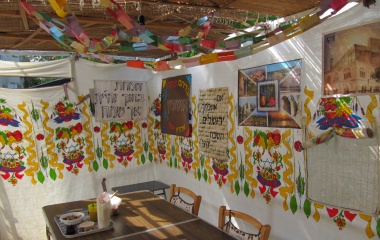
We are to leave the comfort of our home and literally go to the outside world. It is the time to reflect on the issues facing mankind as a whole – war and peace, the economy, the environment, energy, the future of democracy – and then go out and do something about it. Universal concerns are Jewish concerns too.
But the Torah does not just want that we build a sukkah for ourselves. We are to build an even greater Sukkah, one dedicated to G-d. While we may rejoice at the harvest time as a matter of course, the Torah immediately follows by instructing us, “Seven days are you to be festive for the Lord your G-d, in the place G-d chooses, for your G-d, will bless you in all your produce and in all your endeavours; and you shall experience pure joy”.
We must take our blessing and acknowledge that without G-d’s blessing we would have much less. So much of our success – and there is no area where this is truer than farming – is dependent on factors beyond our control. We may talk all we want about it but there is little we can do to control the weather – and such is likely even more true today than it was 3,000 years ago.
The difference between a sukkah built for oneself and one for G-d is highlighted in an illuminating Talmudic passage at the beginning of Tractate Avodah Zara, a tractate which deals primarily with relations between Jews and non-Jews. The Talmud has a relatively long “discussion” between G-d and the nations of the world who complain that G-d has unfairly punished them. G-d “agrees” to their request to be given an opportunity to fulfill a mitzva, thereby demonstrating they are just as worthy as the Jewish people. “I have an easy mitzva to fulfill", G-d says "and its name is sukkah; go and perform it”. (Avodah Zara 2b) Out they went to go and build sukkot. Yet when the weather became very hot they “kicked’ their sukkot as they sought greater shade. While it is true that one is not obligated to sit in a sukkah if it is uncomfortably hot (or more likely cold) there was no reason to kick, to get mad so to speak, at the sukkah.
One can “kick” something one builds for oneself but one dare not kick something builds for G-d. The nations of the world were unable to convert their own personal sukkot to a sukkah built to G-d.
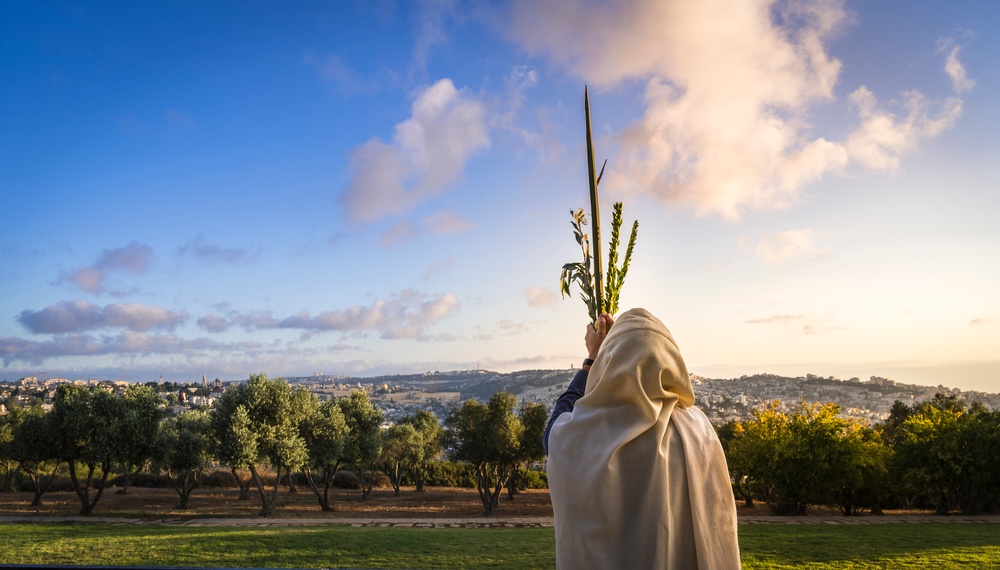
Such a sukkah is open to all, is one where we can look heavenly and try to count the stars. It is a place to think big as the nation founded on Pesach strives to bring the sukkot shalom, the canopy of peace to all mankind.
[1] This is based on the Torah listing 70 descendants of Noach. It could have listed any number but choose to list 70 which is, not coincidentally, also the number that represents the Jewish people whose history begins when 70 people went down to Egypt. That both the world at large and the Jewish people emanates from 70 people is an indication that the Jewish people must be part of the world at large.